|
|
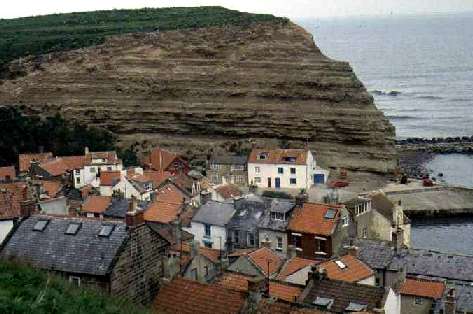
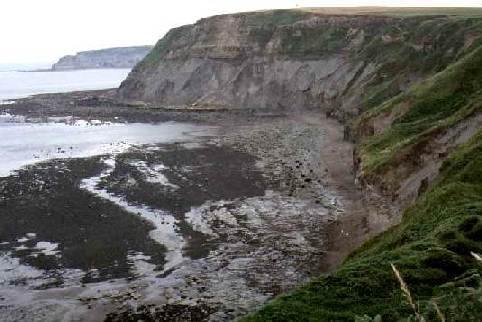
The Coastline between Staithes and Port Mulgrave
|
FORMATION |
MEMBER |
|
Whitby Mudstone |
Alum Shale |
|
Cleveland Ironstone |
Kettleness |
|
Staithes Sandstone |
|
|
Redcar Mudstone |
|
|
|
Perhaps one of the most famous Jurassic sites in Northern England is on
the North Yorkshire coast between Staithes and Port
Mulgrave. The rocks exposed are Lower Jurassic, all of which were deposited
in marine conditions of varying depth. The formations and members are
illustrated in the table above. Check the tides
before doing this traverse!
|
|
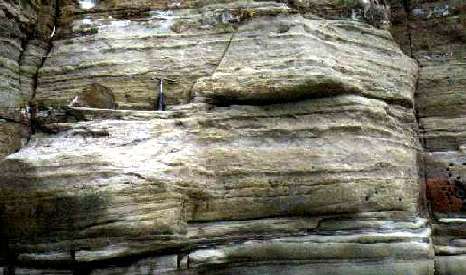
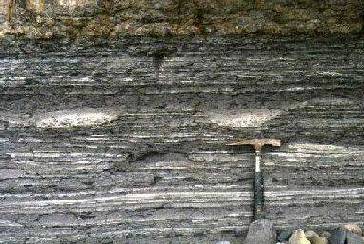
The Staithes
Sandstone Formation (SSF) consists of shallow marine sandstones and
siltstones. Notable features, as seen in the illustration to the left, are
well bedded coarser sandstones alternating with finer sediments where the
bedding has been destroyed due to bioturbation. Cowbar
Nab is the type locality for this formation. |
|
|
|
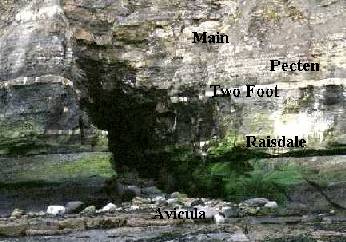
Above the SSF is the Cleveland Ironstone Formation (CIF), so named
because of the ironstone seams which were once quarried or mined. |
|
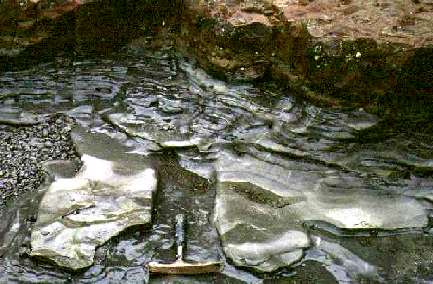
Another interesting
feature to be seen within the the CIF in Jet Wyke are the so called "striped beds" with
infilled gutters. The gutters can be seen below the Raisdale
Seam in plan view, to the right, and cross section,
as illustrated below. The striped beds and gutters are believed to have been
caused by storm conditions, and are known as "tempestites". |
|
|
|
|
|
The coastline between Staithes and Port
Mulgrave is quite fossiliferous. It is, however, a Site of Special Scientific
Interest and therefore collections must only be made from loose material.
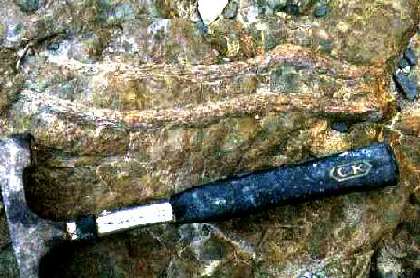
Examination of the Main Seam will reveal many horizontal U shaped burrows,
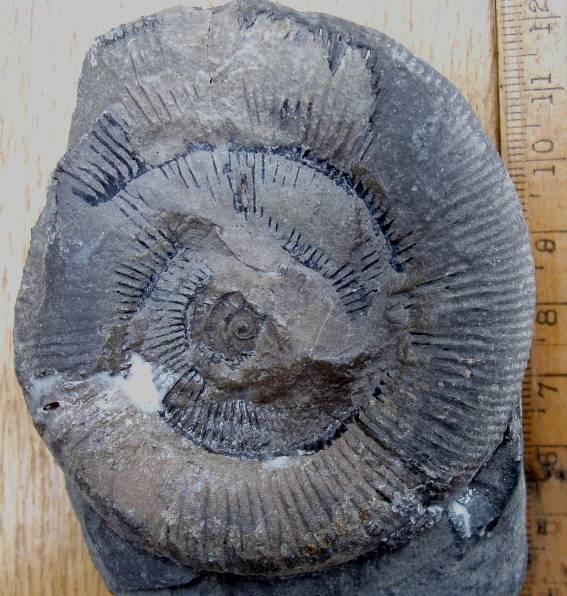
above right, believed to have been made by a shrimp like creature named Rhizocorallium. The Grey Shale
Member is best exposed in Brackenberry Wyke. Here, specimens of the zonal ammonite Dactylioceras tenuicostastum
can be found. |
|
|
|
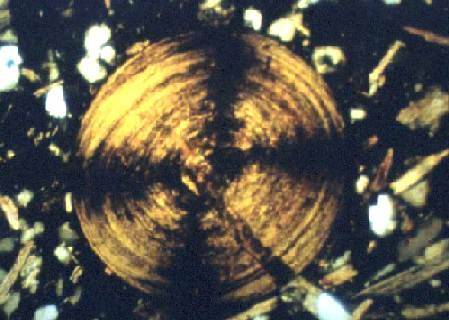
Many of the Jurassic ironstones contain ooliths consisting of concentric layers of chamosite, an iron silicate, or their derivatives, berthierine or goethite. They are formed by the precipitation of minerals around a nucleus, e.g. a shell fragment being rolled around by oscillating currents. The concentric structure of the mineral results in a cruciform extinction pattern when viewed under the microscope with cross polarised light. The illustration to the left shows an oolith which is 1mm in diameter. |
|
From Brackenberry Wyke
to Rosedale Wyke at Port Mulgrave the overlying
Mulgrave Shale and Alum Shale Members are exposed in the cliffs. Pieces of
jet, a hard black type of lignite derived from wood belonging to auracarian trees resembling the modern day Monkey Puzzle
tree, can occasionally be found among the rocks on the shore in Rosedale Wyke. |
|
More information about this area can be
found in the following excellent guides: the G.A. guide "The Yorkshire
Coast",
the Y.G.S. guide "Yorkshire Rocks and Landscape". Details
can be found on the Recommended Reading page.
|
|
To return to the Jurassic period, click here.